January 17, 2003 / 52(02);24-26

http://www.cdc.gov/mmwr/preview/mmwrhtml/mm5202a2.htm

Outbreak of Botulism Type E Associated with Eating a Beached Whale ---
Western Alaska, July 2002

Botulism is a neuroparalytic illness caused by toxins produced by the
bacterium Clostridium botulinum, an obligate anaerobe found commonly
in the environment. Intoxication with toxin type E is associated
exclusively with eating animal foods of marine (salt or fresh water)
origin. Persons who eat raw or fermented marine fish and mammals are
at high risk for botulism from type E toxin. On July 17, 2002, the
Alaska Division of Public Health investigated a cluster of suspected
botulism cases among residents of a fishing village in Alaska. This
report summarizes the findings of the outbreak investigation, which
linked disease to eating raw muktuk (skin and a pink blubber layer)
from a beached whale (Figure). To avoid delays in treatment,
health-care providers evaluating patients suspected of having botulism
should base treatment decisions on clinical findings. Public health
authorities should be notified immediately about any suspected
botulism case.

During July 13--15, residents of a western Alaska village on the
Bering Sea shore shared a meal consisting of muktuk harvested from a
beached adult beluga whale found near their village. The villagers
estimated that the whale had been dead for at least several weeks.
They cut the whale fluke (tail) into pieces and stored them in
zipper-sealed plastic bags in a refrigerator until they were eaten 1
or 2 days later. On July 17, after a physician from western Alaska
reported three suspected cases of botulism among patients who had
eaten the muktuk, the Alaska Section of Epidemiology began an
investigation.

A case of foodborne botulism was defined as illness in a person who
had eaten the muktuk and subsequently had symmetric descending flaccid
paralysis of motor and autonomic nerves. Persons who ate muktuk were
interviewed and examined, and their hospital records were reviewed.
Serum, stool, and gastric contents from patients and leftover blubber
were tested for botulinum toxin.

Of 14 persons identified who ate the muktuk, eight (57%) had an
illness that met the case definition. Five of the eight patients were
female; the median age was 73 years (range: 13--83 years). Symptom
onset after ingestion of muktuk occurred within 36 hours in all
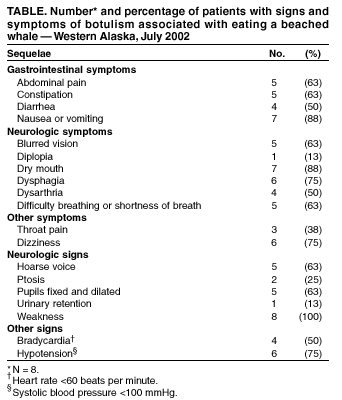
patients (Table). Five patients were hospitalized, four received
antitoxin, and two required mechanical ventilation. Three stool, three
gastric fluid, and seven serum samples from the eight patients and
seven samples of muktuk were tested for botulinum toxin at CDC's
National Botulism Surveillance and Reference Laboratory. The
diagnostic laboratory received all laboratory specimens on July 26,
and results were reported on August 1. Type E toxin was detected in
stool from one patient. All seven samples of muktuk were positive for
type E botulinum toxin.

Reported by: J Middaugh, MD, T Lynn, DVM, B Funk, MD, B Jilly, PhD,
Div of Public Health, Alaska Dept of Health and Social Svcs. Div of
Bacterial and Mycotic Diseases, National Center for Infectious
Diseases; S Maslanka, PhD, Div of Applied Public Health Training,
Epidemiology Program Office; J McLaughlin, MD, EIS Officer, CDC.

Editorial Note:

This report summarizes a foodborne outbreak of botulism in a western
Alaska village that resulted from residents eating muktuk contaminated
with type E botulinum toxin. During 1973--1998, a total of 814 cases
and an annual median of 24 cases (range: 14--94 cases) of foodborne
botulism were reported to CDC (1); 236 (29%) of these cases occurred
in Alaska (CDC, unpublished data, 2003). Although botulism is a rare
disease, its presentation is distinctive (Box. Because of the epidemic
potential of foodborne botulism, every case should be reported and
investigated immediately.

All patients suspected of having foodborne botulism should be placed
in an intensive care setting, monitored regularly for respiratory
function deterioration, and provided mechanical ventilation if
necessary. Prompt administration of polyvalent equine-source antitoxin
can decrease the progression of paralysis and severity of illness but
will not reverse existing paralysis. Botulinum antitoxin is available
in the United States only through the public health system. Therefore,
rapid clinical diagnosis, notification of public health authorities,
and timely administration of antitoxin are imperative (2). Laboratory
confirmation of botulinum intoxication cannot be relied on in making
treatment decisions because the standard test, the mouse bioassay,
requires approximately 4 days for final results (2). In addition, the
sensitivity of laboratory testing of clinical samples is low (3,4). In
this outbreak, typed toxin was detected in only 8% of samples from
patients who had definitive exposure to contaminated muktuk.

The probable mode of contamination of the whale in this outbreak was
either growth and toxin secretion by C. botulinum present in the
intestinal tract of the whale or traumatic introduction of C.
botulinum spores into the beached whale tissue from contact with sand,
rocks, and driftwood, and subsequent germination and toxin production.
C. botulinum type E has been found in Alaska coastline soil (5), and
outbreaks of botulism associated with eating beached marine mammals
are documented (Alaska Section of Epidemiology, unpublished data,
2003). A previous report on the accumulation of C. botulinum toxins in
the North Sea coastal food chain associated with beached whales
suggested the disposal of the carcasses as a preventive measure (6).
However, because of the impracticality of frequent scanning of the
vast Alaska shoreline and high costs associated with disposal, the
U.S. Fish and Wildlife Service does not remove beached mammal
carcasses regularly.

Because of the epidemic potential of foodborne botulism and the status
of botulinum toxins as a category A agent of terrorism, health-care
providers should be familiar with the presentation of botulism.
Treatment is based on clinical diagnosis, and rapid recognition and
reporting of cases are the cornerstones of successful public health
interventions to prevent additional illnesses. Persons should avoid
eating beached marine mammal carcasses and boil raw or fermented
Alaska Native dishes >10 minutes before eating to inactivate botulinum
toxin. Additional information on botulism prevention is available at
http://www.phppo.cdc.gov/phtn/botulism/alaska/alaska.asp and
http://www.epi.hss.state.ak.us/pubs/botulism/bot_01.htm.

http://www.cdc.gov/mmwr/preview/mmwrhtml/figures/m202a2t.gif
TABLE. Number* and percentage of patients with signs and
symptoms of botulism associated with eating a beached
whale-Western Alaska, July 2002

References

    1. Shapiro RL, Hatheway C, Swerdlow DL. Botulism in the United
States: a clinical and epidemiologic review. Ann Intern Med
1998;129:221--8.

    2. Arnon SS, Schechter R, Inglesby TV, et al. Botulinum toxin as a
biological weapon: medical and public health management. Available at
http://jama.ama-assn.org/issues/v285n8/ffull/jst00017.html#a6.

    3. Woodruff BA, Griffin PM, McCroskey LM, et al. Clinical and
laboratory comparison of botulism from toxin types A, B, and E in the
United States, 1975--1988. J Infect Dis 1992;166:1281--6.

    4. Dowell VR Jr, McCroskey LM, Hatheway CL, et al.
Coproexamination for botulinal toxin and clostridium botulinum: a new
procedure for laboratory diagnosis of botulism. JAMA 1977;238:1829--32.

    5. Miller LG. Observations on the distribution and ecology of
Clostridium botulinum type E in Alaska. Can J Microbiol 1975;21:920--6.

    6. Stede M. Problems of disposal of dead marine mammals. Dtsch
Tierarztl Wochenschr 1997;104:245--7.

_/_/_/_/_/_/_/_/_/_/_/_/_/_/_/_/_/_/_/_/_/_/_/_/_/_/_/_/_/_/_/_/_/_/_/_/_/_/
_/

BOX. Epidemiology, diagnosis, treatment, and prevention of
foodborne botulism

Epidemiology
* Caused by eating foods contaminated with preformed toxins of
Clostridium botulinum
* Home-canned foods and raw or fermented Alaska Native dishes commonly
associated with illness
* During 1973-1998, a total of 814 cases and an annual median of 24
cases (range: 14-94 cases) of foodborne botulism
reported in the United States; 236 (29%) in Alaska * Humans affected
by toxin types A, B, E, and rarely F;
type E intoxication associated exclusively with eating marine animals
* Classified as a category A terrorism agent

Clinical findings
* Cranial nerve palsies
* Symmetrically descending flaccid voluntary muscle weakness possibly
progressing to respiratory compromise
* Normal body temperature
* Normal sensory nerve examination findings
* Intact mental status despite groggy appearance
* Differential diagnosis includes Guillain-Barré syndrome, myasthenia
gravis, stroke, drug overdose, and other entities

Laboratory findings
* Normal cerebrospinal fluid values
* Specific electromyography (EMG) findings including
  - normal motor conduction velocities
  - normal sensory nerve amplitudes and latencies
  - decreased evoked muscle action potential
  - facilitation following rapid repetitive nerve stimulation
* Standard mouse bioassay positive for toxin from
clinical specimens and/or suspect food; requires up to
4 days for final results

Recommended treatment
* Prompt administration of polyvalent equine-source antitoxin
  - can decrease the progression of paralysis and severity of illness
  - will not reverse existing paralysis
  - available in the United States only through the public health system
* Place suspect cases in an intensive care setting
* Monitor for respiratory function deterioration every 4 hours using
forced vital capacity testing
* Provide mechanical ventilation if necessary

Prevention and control
* Boil raw or fermented Alaska Native dishes and homecanned foods >10
minutes before eating
* Follow recommended home-canning procedures
* Notify state health department immediately of suspected cases
***************************************************************************
PaddleWise Paddling Mailing List - Any opinions or suggestions expressed
here are solely those of the writer(s). You must assume the entire
responsibility for reliance upon them. All postings copyright the author.
Submissions:     PaddleWise_at_PaddleWise.net
Subscriptions:   PaddleWise-request_at_PaddleWise.net
Website:         http://www.paddlewise.net/
***************************************************************************
Big snip>
> Outbreak of Botulism Type E Associated with Eating a Beached Whale ---
> Western Alaska, July 2002


That does it.....I'm *never* eating raw whale again!

steve

***************************************************************************
PaddleWise Paddling Mailing List - Any opinions or suggestions expressed
here are solely those of the writer(s). You must assume the entire
responsibility for reliance upon them. All postings copyright the author.
Submissions:     PaddleWise_at_PaddleWise.net
Subscriptions:   PaddleWise-request_at_PaddleWise.net
Website:         http://www.paddlewise.net/
***************************************************************************
[Moderator's Note: Content unaltered. Excessive quoting (i.e.  headers/footers/sig lines/extraneous text from previous posts, etc.) have been removed. Please edit quoted material in addition to removing header/trailers when replying to posts.]

>That does it.....I'm *never* eating raw whale again!
>
>steve

Ah but Steve that means you will never enjoy the ultimate gormet meal of
fresh whale muktuk dipped in seal oil with a fermemted walrus flipper as a
side dish.

from the land of moose nose, herring row on kelp and stink eggs (you really
don't want to know about that one)
Bob
in Alaska where "there are strange things done 'neath the midnight sun".
***************************************************************************
PaddleWise Paddling Mailing List - Any opinions or suggestions expressed
here are solely those of the writer(s). You must assume the entire
responsibility for reliance upon them. All postings copyright the author.
Submissions:     PaddleWise_at_PaddleWise.net
Subscriptions:   PaddleWise-request_at_PaddleWise.net
Website:         http://www.paddlewise.net/
***************************************************************************
From: "Rev. Bob Carter" <revkayak_at_aptalaska.net>

> in Alaska where "there are strange things done 'neath the midnight sun".


Whaaa!?!?!?   That's the Yukon!!  Thief!!!

:-)

Mike
***************************************************************************
PaddleWise Paddling Mailing List - Any opinions or suggestions expressed
here are solely those of the writer(s). You must assume the entire
responsibility for reliance upon them. All postings copyright the author.
Submissions:     PaddleWise_at_PaddleWise.net
Subscriptions:   PaddleWise-request_at_PaddleWise.net
Website:         http://www.paddlewise.net/
***************************************************************************
Rev. Bob Carter wrote:

>>That does it.....I'm *never* eating raw whale again!
>>
>>steve
>>
>>
>
>Ah but Steve that means you will never enjoy the ultimate gormet meal of
>fresh whale muktuk dipped in seal oil with a fermemted walrus flipper as a
>side dish.
>
>
In northern Norway last summer we were served an elegant appetizer
consisting of strips of raw whale (red meat, not muktuk) interlaced in a
cunning checkerboard pattern with strips of raw halibut, served on a bed
of iceberg (not that kind) lettuce. Quite nice, and actually better than
the whale steaks we had the next night, which had a certain liverish
quality about them. The restaurant was were fresh (?) out of fermented
walrus flipper.

Steve Cramer

***************************************************************************
PaddleWise Paddling Mailing List - Any opinions or suggestions expressed
here are solely those of the writer(s). You must assume the entire
responsibility for reliance upon them. All postings copyright the author.
Submissions:     PaddleWise_at_PaddleWise.net
Subscriptions:   PaddleWise-request_at_PaddleWise.net
Website:         http://www.paddlewise.net/
***************************************************************************
Maybe, maybe, there´s a reason Inuit/Eskimos never "invented" ziplock
freezing bags??

Botulism doesn´t "like" Oxygen, this special bacteria "work" only without
oxygen.
Give Oxygen a chance! And your food, even Muktuk, keeps you up.

Jochen - just read Fred Bruemmer magnificient book "Living with the Inuit".
Aaahhh, great stuff!!!

***************************************************************************
PaddleWise Paddling Mailing List - Any opinions or suggestions expressed
here are solely those of the writer(s). You must assume the entire
responsibility for reliance upon them. All postings copyright the author.
Submissions:     PaddleWise_at_PaddleWise.net
Subscriptions:   PaddleWise-request_at_PaddleWise.net
Website:         http://www.paddlewise.net/
***************************************************************************
I was wondering just what this Muktuk stuff was...I bet others are
curious as well...here is what I found:

Muktuk is the outer covering of the whale. It includes the white
skin, approximately 1-2 inches (2 1/2 - 5cm) thick, plus a thin
pinkish layer immediately underneath. After taking blocks from the
whale, leave 2 days hanging to dry. Cut into pieces 6 x 6 inches
(15x15cm). Have water ready to boil. Cook until it tests tender when
pierced with a fork. Keep in oil in a 45 gallon (206 litre) drum
after it is cooled. Store in a cool place and you will have muktuk
all year. Most Inuit prefer to eat muktuk raw, as it has tender-crisp
texture and tastes like fresh coconut.
***************************************************************************
PaddleWise Paddling Mailing List - Any opinions or suggestions expressed
here are solely those of the writer(s). You must assume the entire
responsibility for reliance upon them. All postings copyright the author.
Submissions:     PaddleWise_at_PaddleWise.net
Subscriptions:   PaddleWise-request_at_PaddleWise.net
Website:         http://www.paddlewise.net/
***************************************************************************
Most Inuit prefer to eat muktuk raw, as it has tender-crisp
> texture and tastes like fresh coconut.


In Greenland a couple of years ago we came across a group of local people
just pulling a whale up on shore to be cut up.  It was a fin whale about
seventy feet long.  Once the flensing started we managed, through sign
language, to get the folks to give us some of the skin and fat to eat.
The skin was exactly, in texture and consistency (no taste that I could
detect) like a bicycle inner tube.  The fat, however, was like really
good prime rib.  One of the people told us that fin is the best tasting
whale.  It was deliecious.

Jim Tibensky
***************************************************************************
PaddleWise Paddling Mailing List - Any opinions or suggestions expressed
here are solely those of the writer(s). You must assume the entire
responsibility for reliance upon them. All postings copyright the author.
Submissions:     PaddleWise_at_PaddleWise.net
Subscriptions:   PaddleWise-request_at_PaddleWise.net
Website:         http://www.paddlewise.net/
***************************************************************************
. Most Inuit prefer to eat muktuk raw, as it has tender-crisp
>texture and tastes like fresh coconut.

Actually from experience muktuk is often anything but tender (read chew and
chew and chew)
the taste I would describe as a nutty flavor with a hint of fish.

Bob who prefers pizza
>


***************************************************************************
PaddleWise Paddling Mailing List - Any opinions or suggestions expressed
here are solely those of the writer(s). You must assume the entire
responsibility for reliance upon them. All postings copyright the author.
Submissions:     PaddleWise_at_PaddleWise.net
Subscriptions:   PaddleWise-request_at_PaddleWise.net
Website:         http://www.paddlewise.net/
***************************************************************************
This archive was generated by hypermail 2.4.0 : Thu Aug 21 2025 - 16:33:32 PDT